
The Kearney 7-step strategic sourcing framework: 2026 guide


Procurement leaders today face a familiar set of challenges: fragmented supplier management, uncontrolled tail spend, and limited visibility into spend data. Add in supply chain volatility, inflation, and new sustainability mandates, and it’s no surprise that many organizations may struggle to remain proactive in the face of these challenges.
But strategic sourcing offers a way forward. By applying structured analysis, stakeholder alignment, and continuous improvement, procurement teams can now move from tactical cost-cutting to long-term value creation.
This guide covers the principles, frameworks, and phases of strategic sourcing and how operationalizing these practices can improve resilience, help you stay compliant with organizational policies, and gain a measurable ROI.
What is strategic sourcing?
Strategic sourcing is the practice of aligning supplier selection and management with long-term business goals. It moves beyond “lowest price wins” to consider total cost of ownership (TCO), supplier risk, and organizational priorities like sustainability and resilience.
Procurement leaders must control costs, strengthen resilience, and improve compliance while creating long-term value across the supply base. Strategic sourcing aligns supplier selection and management to those objectives, linking evaluation criteria, policies, and performance to business goals.
How is strategic sourcing different from traditional procurement?
Many procurement leaders use these terms interchangeably, but there is a critical difference between traditional procurement and strategic sourcing when it comes to supply chain management.
Traditional procurement focuses on transactions and lowest unit cost. This process ultimately prioritizes speed and price. However, strategic sourcing deals more with optimizing supplier value, resilience, and long-term ROI. It takes a broader view of supplier relationships, risk, and business objectives.
The shift from tactical purchasing to strategic sourcing means moving beyond one-off savings. Instead, it involves building long-term value and resilience into your supply chain.
Strategic sourcing vs. category management
Strategic sourcing and category management address different phases of procurement management.
Strategic sourcing is a project-based process for evaluating, selecting, and contracting with suppliers in a specific spend area.
Category management is an ongoing organizational strategy for maximizing the value of an entire spend category over time.
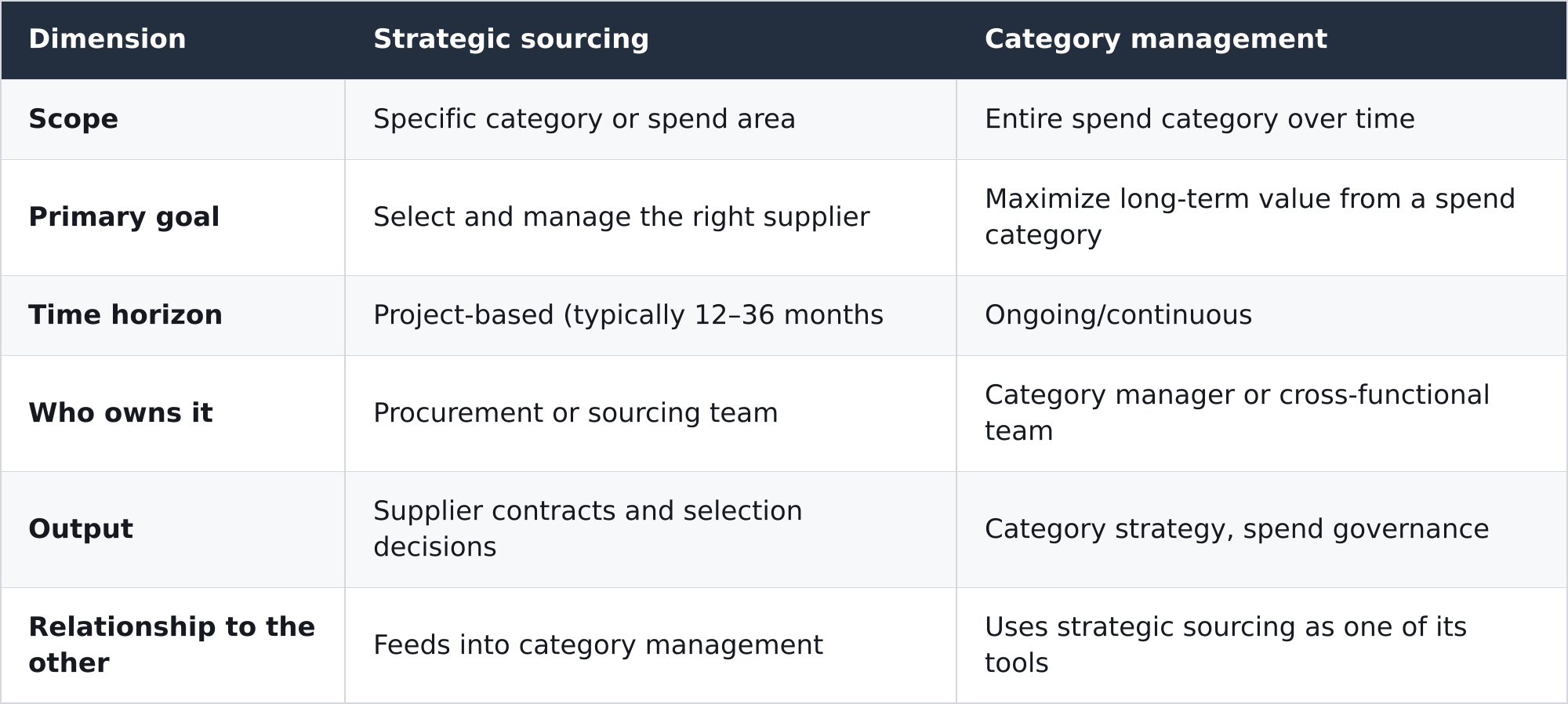
In practice, strategic sourcing and category management work together. Strategic sourcing is the how of picking suppliers, and category management is the why and when.
What are the benefits of strategic sourcing?
Strategic sourcing provides clear benefits that extend beyond cost savings. By aligning sourcing practices with organizational goals, procurement leaders can unlock value in these key areas:
Stronger supply chain resilience: This type of sourcing reduces the risk of disruption from geopolitical shifts, raw material shortages, and logistics delays, which could undermine operations.
Improved responsibility: It also supports sustainable and responsible purchasing (SRP) commitments by making it easier to source from suppliers with the certifications that matter to your organization while strengthening long-term competitive advantage.
Better financial performance: Using this process drives cost reduction and strengthens category management through supplier consolidation and smarter sourcing.
Increased innovation and collaboration: Strategic sourcing strengthens supplier partnerships that enable innovation, joint problem-solving, and even co-development of solutions, whether through direct contracts or carefully managed outsourcing.
Improved operational efficiency and visibility: Streamlining sourcing processes reduces manual effort, while spend analysis and automation provide the transparency needed to monitor and control purchasing behavior.
Easier supplier relationship optimization: You can build trusted, long-term supplier partnerships that improve service levels, contract outcomes, and overall profitability.
Together, these benefits position procurement as a strategic driver of efficiency, compliance, resilience, and innovation rather than a purely transactional function.
What are common sourcing business models?
Procurement leaders often explore different sourcing business models to structure supplier relationships, ranging from transactional contracts to long-term partnerships. These models provide a way to balance accountability, investment, and performance expectations.
These are some of the most common sourcing business models:
Primary provider: A single supplier is responsible for delivering a specific good or service.
Authorized provider: The organization approves a vetted supplier to meet defined organizational requirements.
Elected provider: The business chooses a group of suppliers through competitive evaluation.
Performance-based model: Suppliers receive compensation based on the results or outcomes they achieve.
Vested model: This hybrid model combines transactional elements with partnership-based investment.
Communal services model: Multiple organizations share supplier resources for efficiency.
Fair play partnership model: Each party shares risk and reward transparently in this collaborative relationship.
Choosing the right model is only part of the equation. Operationalizing it across teams is where procurement strategies often break down.
To bridge this gap, organizations can use tools like Guided Buying, supplier certifications, and approval workflows to enforce sourcing models at scale. These capabilities help reduce policy violations and align purchases with strategic goals, from supplier consolidation to SRP initiatives, turning sourcing strategy into day-to-day execution.
What are strategic sourcing frameworks?
Strategic sourcing frameworks provide procurement leaders with structured approaches for making sourcing decisions. They also help organizations balance cost, risk, and value creation in a consistent way.
Common frameworks include the following:
Kraljic Matrix: This matrix involves segmenting suppliers into categories (like leverage, strategic, bottleneck, and non-critical) based on supply risk and business impact. This helps leaders prioritize resources.
Porter’s Five Forces: This framework involves evaluating supplier power, buyer power, competitive rivalry, threat of substitutes, and threat of new entrants to understand market dynamics.
SWOT Analysis: This analysis helps teams identify strengths, weaknesses, opportunities, and threats in sourcing strategy to ensure alignment with business goals.
TCO: This model goes beyond purchase price to factor in costs like maintenance, logistics, and disposal.
Procurement teams use these frameworks to shape sourcing strategies. Amazon Business then helps you put those strategies into action with robust compliance management tools and transparent supplier and product certifications. These tools give teams the controls and visibility needed to operationalize sourcing decisions in day-to-day procurement.
7 phases of the strategic sourcing process
This seven-phase framework was developed by A.T. Kearney, one of the world's leading procurement consulting firms, and is the most widely adopted structured sourcing methodology globally.
Phase 1: Profile the category
Start by defining what you're sourcing and understanding your current spend in that category. Pull purchase history, identify the key suppliers you're currently using, and document the specifications, quantities, and delivery requirements that define your needs.
Use procurement analytics at this stage to get a complete picture of your current spend: who's buying what, from whom, and at what frequency. Most organizations find that their actual spend patterns differ significantly from their formal supplier agreements once they look at the full transaction record.
Phase 2: Supply market assessment
Research the supplier landscape for your category. Who are the qualified suppliers globally, regionally, and locally? What's the competitive structure of the supply market? Are there supply constraints, material shortages, or consolidation trends that affect your options?
This phase also includes benchmarking your current pricing against market rates. Understanding where your current costs sit relative to the market is essential for realistic negotiation targets.
Phase 3: Develop the sourcing strategy
Based on the Kraljic Matrix classification of your category and your supply market findings, decide on the right sourcing model: competitive RFP, preferred supplier arrangement, strategic alliance, or other approach.
This is also the phase where you decide scope: are you sourcing globally, regionally, or locally? Are you consolidating to fewer suppliers or diversifying? What SRP criteria will you apply?
Phase 4: Select the suppliers and negotiate
Issue an RFP or Request for Quote (RFQ) to your qualified supplier list. Evaluate responses against defined criteria: cost, quality, delivery capability, financial stability, compliance record, and SRP certifications.
This is where structured competitive evaluation creates measurable value. Amazon Business customers can save an average of 17% on large planned purchases through the Amazon Business RFQ capability, a direct application of Phase 4 competitive supplier evaluation. Best practice holds that your negotiations should be anchored to your market benchmark data from Phase 2, not to the supplier's opening position.
Phase 5: Negotiate and implement
Finalize contract terms with the selected supplier or suppliers. Cover pricing, payment terms, delivery windows, service levels, quality standards, and dispute resolution. Once contracts are executed, manage the transition from previous suppliers and communicate the new terms internally.
Implementation also means ensuring that buyers across the organization know which suppliers to use, how to order, and what the approved terms are. A new supplier contract that no one knows about doesn't deliver its intended savings.
Phase 6: Integrate with the supply chain
After implementation, connect the sourcing decisions made in Phases 4 and 5 with your broader supply chain planning. Share forecast data with new suppliers so they can plan capacity. Establish regular review cadences for demand updates. Build the supplier into your inventory and replenishment models.
Supplier integration failures at this phase are a common reason why sourcing savings don't materialize. The contract savings are real, but operational friction or poor communication erodes them.
Phase 7: Conduct supplier benchmarking and regular review
Track supplier performance against contracted terms and agreed KPIs: on-time delivery, quality acceptance rates, invoice accuracy, and responsiveness. Review performance at regular intervals, share data with the supplier, and use the review process to drive continuous improvement.
Benchmarking means checking regularly whether the market has moved since you contracted. If your terms are no longer competitive, Phase 7 feeds back into Phase 2, and the cycle begins again.
Strategic sourcing best practices
An effective sourcing strategy turns high-level procurement goals into day-to-day actions and governance controls. It also ensures that sourcing decisions support cost savings, compliance, and resilience while remaining adaptable to market conditions.
Here’s how organizations can put their sourcing strategy into practice:
Start with a clear spend analysis
Tail spend and duplicate supplier contracts often remain invisible in large organizations. But you can surface these potential inefficiencies by segmenting spend categories.
Tools like Spend Visibility (a Prime Business feature) make it easier to identify opportunities for consolidation. These insights often translate into measurable cost savings by consolidating suppliers and leveraging bulk discounts.
Define your sourcing objectives
Without measurable objectives, sourcing efforts lose focus and fail to deliver ROI.
To counter this issue, it’s helpful to set SMART goals, or objectives that are specific, measurable, achievable, relevant, and time-bound. For example, your SMART goal could involve reducing TCO by 10% or diversifying 20% of spend. You can then translate these objectives into enforceable rules by setting up approval workflows and buying policies.
Embedding these rules reduces compliance risk and helps teams avoid costly off-contract purchases.
Apply a sourcing framework to prioritize categories
Procurement teams under pressure to deliver savings often default to prioritizing cost alone. But this narrow focus can be dangerous, especially at the enterprise level.
Low-cost suppliers may introduce hidden risks: long lead times, inconsistent quality, compliance violations, or lack of resilience in the face of disruption. A supplier offering the lowest price today might ultimately cost more in the long run if they fail to meet SLAs, require constant oversight, or expose the organization to regulatory or reputational risk.
Pro tip: Over-indexing on cost can undermine ROI by increasing total cost of ownership (TCO), supply chain instability, and non-compliance risk.
To avoid this, enterprise procurement leaders should apply structured sourcing frameworks that balance cost, risk, and strategic impact across categories. Tools like the Kraljic Matrix or TCO models help prioritize high-risk or high-impact categories and allocate resources accordingly.
Applying a sourcing framework ensures organizational alignment, reduces spend leakage with non-preferred vendors, and enables more strategic decision-making. It also helps justify procurement decisions to finance, risk, and executive stakeholders, grounding tradeoffs in data, not gut instinct.
Shortlist and evaluate suppliers
Sourcing from non-compliant or high-risk suppliers can expose organizations to legal and reputational risks. But you can reduce this risk by evaluating suppliers based on your preferred characteristics, such as diverse ownership, certifications, and compliance. Then, create a list of preferred suppliers who will help you meet your business goals.
Implementing tools like Guided Buying helps steer procurement teams toward preferred suppliers while blocking non-compliant vendors. This minimizes the risk of regulatory penalties while ensuring that spend supports organizational SRP goals.
Build in governance and compliance controls
Without strong governance, employees often bypass policies, whether intentionally or unknowingly, which leads to cost leakage, off-contract spend, and compliance risk.
To prevent this, organizations need to turn sourcing strategy into everyday controls that guide employee purchasing behavior. You can do this through workflows, catalog governance, and purchase limits that are embedded directly into your procurement systems. Building these guardrails into daily purchasing reduces policy violations, strengthens compliance reporting, and lowers leakage costs across the organization.
Create a roadmap for continuous improvement
Market dynamics and business needs change quickly, but sourcing strategies often remain static.
To continuously iterate on your strategy, you should treat sourcing as a living process. This involves implementing ongoing reviews, which help procurement leaders capture new savings opportunities and demonstrate ROI year over year.
Pro tip: Amazon Business helps procurement leaders operationalize their sourcing strategies by enabling them to do the following:
Set spend thresholds and budget limits with Budget Management
Highlight certified sustainable and local suppliers, and
Block or limit suppliers that don’t meet compliance standards with Guided Buying
Establish permissions and approval workflows across teams with Buying Policies and Approvals
These capabilities allow procurement teams to enforce sourcing policies without slowing down purchasing. This creates a balance of control and flexibility.
How to build sourcing alignment
Strategic sourcing isn’t just a procurement initiative. Success also depends on collaboration across finance, operations, IT, and legal.
Who should be on your sourcing governance team?
Building cross-functional alignment begins with the right governance team. Procurement leaders should involve stakeholders who bring diverse perspectives and can ensure that sourcing aligns with both operational and strategic objectives. Here are a few of these stakeholders and what they bring to the table:
Procurement lead: Drives sourcing strategy, monitors performance, and ensures alignment with business goals
Finance stakeholder: Oversees budget impact, ROI tracking, and compliance with financial policies
Operations liaison: Ensures that sourcing decisions support day-to-day operations and supply chain needs
IT and risk management: Addresses technology integration, data security, and vendor risk assessment
Legal counsel: Manages contract terms, compliance requirements, and risk mitigation
How to drive stakeholder buy-in and adoption
Winning support requires more than just presenting a strategy. Leaders must also demonstrate impact and provide tools that make compliance easy. For example, a procurement leader might do the following:
Conduct stakeholder mapping and interviews
Pilot sourcing initiatives before scaling
Establish sourcing rules to simplify compliance for employees
Pilot programs that highlight savings and compliance benefits make it easier to scale adoption across the organization.
3 trends shaping strategic sourcing
The following three major trends are currently shaping the future of strategic sourcing:
1. Supply chain resilience
Procurement teams learned during the disruptions of the early 2020s that single-source and lowest-cost-only strategies carry hidden costs that only appear when the supply chain is stressed. The shift since then has been toward deliberate resilience: dual-sourcing in critical categories, regional sourcing as a complement to global sourcing, and active supplier financial health monitoring.
McKinsey found that companies excelling in procurement had digital capabilities maturity scores 40% higher than average performers. That gap reflects the advantage of analytics-driven sourcing over intuition-driven sourcing, especially when assessing and managing supply risk. Procurement risk management frameworks built on real-time data outperform those built on periodic manual reviews.
2. AI and automation in sourcing
Every phase of the Kearney process is being affected by AI:
Spend analytics platforms can now classify and categorize transactions automatically.
Market intelligence tools can suddenly benchmark pricing against real-time supply market data.
Contract review tools can flag risk clauses and non-standard terms at scale.
Supplier risk monitoring platforms can flag financial instability signals weeks before they become supply disruptions.
According to Deloitte's 2025 Chief Procurement Officer Survey, CPOs are focused on digital tools and AI, with highly proficient procurement leaders seeing a 3.2x investment return on average. The procurement leaders pulling ahead are the ones who have already built the data infrastructure that AI requires.
Amazon Business Analytics consolidates purchasing data across the organization, creating the spend visibility layer that makes AI-driven sourcing insights possible. While Spend Anomaly Monitoring is an intelligent tracking system that helps Prime Business Enterprise members maintain greater control over their spending through real-time alerts around unusual purchases.
3. Sustainability and supplier diversity
Socially responsible purchasing is moving from aspirational to operational. Corporate social responsibility mandates are often seen as the biggest external challenge to procurement operations, ranking above unexpected economic changes and rising costs.
Sourcing teams are now expected to evaluate suppliers on SRP criteria alongside traditional cost and quality metrics, track diverse supplier spend, and report on sustainability performance. Organizations that build SRP criteria into their sourcing frameworks, qualification processes, and contract terms early are better positioned to report and improve on those metrics than those that try to overlay SRP after the sourcing decision is made.
Guided Buying gives procurement teams a way to build SRP preferences directly into the purchasing experience, so buyers naturally find preferred and compliant suppliers first.
Turn sourcing strategy into results
Strategic sourcing creates value at every phase of the Kearney process, but only if the process is followed consistently, supported by the right data, and connected to the supply chain operations that depend on it.
At its core, effective sourcing is about more than cost savings, it’s about building trusted supplier partnerships, aligning with business objectives, and driving long-term value across the supply chain. Organizations that operationalize strategic sourcing today won’t just reduce costs, they’ll build more resilient, sustainable, and future-ready supply chains that can adapt as the world changes.
Amazon Business gives procurement teams the tools to run each phase of the Kearney process, from spend analysis through supplier performance monitoring, with RFQ for competitive sourcing, Guided Buying for policy compliance, and Amazon Business Analytics for spend visibility. See how it works for your organization.
Get started today
Was this helpful?




 United States
 India
India United Kingdom
 France
 Germany
 Spain
Spain Italy
Italy Canada
 Japan
Japan Mexico
 Australia


