
How strategic supplier relationship management delivers ROI


Procurement leaders are under increasing pressure to deliver value that extends beyond cost savings. Faced with global supply chain disruptions, evolving compliance mandates, and heightened expectations for responsible purchasing, traditional vendor management falls short of what modern business demands.
To remain competitive and resilient, organizations must adopt a more strategic approach to supplier engagement. This is where supplier relationship management (SRM) becomes essential.
SRM is the strategic framework that enables procurement leaders to achieve greater cost efficiency, enhance supply chain resilience, and align sourcing strategies with the overarching business goal.
What is supplier relationship management?
SRM becomes essential when your organization faces high category complexity, significant supply risk, or relies on strategic suppliers who directly impact your customer value proposition.
Whether you're sourcing specialized components, managing healthcare suppliers, or coordinating materials across multiple sites, a transactional approach to vendor management is no longer sufficient to protect your business.
Effective supplier relationship management strategies deliver measurable gains beyond cost reduction: resilience through collaborative contingency planning, accelerated innovation, and faster response to market shifts.
You can also reduce operational risk with better visibility into supplier performance and compliance. When you invest in SRM, you're building the foundation for a durable competitive advantage.
Supplier management vs. supplier relationship management
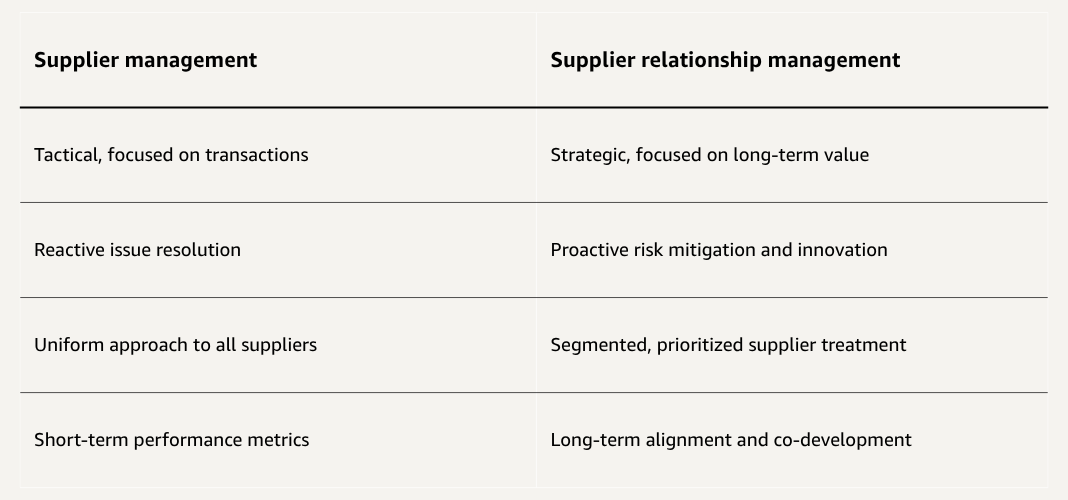
While often used interchangeably, supplier management and supplier relationship management represent different levels of maturity in procurement.
Traditional supplier management focuses primarily on contract management, order handling, and performance monitoring, while supplier relationship management takes a holistic view by maximizing long-term value, reducing risk, and fostering innovation through strategic partners.
The supplier relationship management process is iterative and spans the full lifecycle of each vendor relationship, from onboarding to offboarding.
Why SRM matters in 2026
Procurement professionals are facing intensifying geopolitical uncertainty, which makes it more important than ever to have effective risk mitigation strategies in place.
According to Deloitte’s 2025 Global Chief Procurement Officer Survey, 61 percent of respondents said enhancing supplier collaboration and information sharing is the most effective mitigation strategy. That's not just about managing vendors better; it's about building partnerships that deliver resilience, innovation, and competitive advantage.
An additional Deloitte survey found that more than 60 percent of CPOs considered supplier collaboration the strategy that delivers them the most value.
Because of its ability to simultaneously reduce supply chain risk and increase organizational ROI, supplier relationship management is now non-negotiable. Here are some additional ways it can bring your organization value.
Cost savings and spend visibility
SRM provides the strategic framework to control tail spend, the high-volume, low-value purchases that often fall outside managed procurement. By segmenting your supply base and establishing clear governance, you can consolidate fragmented spending, eliminate redundant vendors, and unlock real negotiating power.
The result is better contract compliance, volume-based discounts, and clear visibility into where every dollar is spent. Effective strategic sourcing is what makes this consolidation possible at scale.
Tools with built-in business analytics, available through Prime Business, turn purchasing data into strategic insight, helping you identify off-contract spend, monitor purchasing trends, and negotiate better terms with preferred suppliers.
Risk management and compliance
Supplier risk, from compliance violations to delivery failures, can disrupt operations and damage your reputation. Effective SRM makes risk management proactive rather than reactive, with structured vetting, clear standards, and contingency planning built in.
Our solution supports certified supplier vetting, so you can source from suppliers providing sustainable products without adding friction to the process. This also makes it easier to vet new suppliers against your standards before they enter your supplier networks.
Driving supplier diversity and innovation
Supplier diversity has evolved from a corporate social responsibility metric into a key driver of competitive advantage. An effective SRM strategy provides the visibility to build a more inclusive supply base, satisfying stakeholder and regulatory demands while unlocking tangible business value.
Diverse suppliers, from small and local businesses to minority- and women-owned firms, can expand an organization’s access to specialized capabilities and new ideas. Working with a broader mix of supplier types helps procurement teams surface different products, services, and innovations that a narrower supply base may overlook.
Core components of a strong SRM strategy
A strong SRM strategy rests on three core components that enable everything else to work. These aren't just process steps; they are the strategic pillars that ensure your program creates measurable value instead of administrative overhead.
Supplier segmentation
Not all suppliers warrant the same level of investment. Supplier segmentation is the framework for classifying your supply base, allowing you to tailor engagement based on each supplier's strategic importance and risk profile. Use these criteria to evaluate your suppliers:
Spend volume: How much does your organization spend with this supplier annually?
Strategic criticality: How essential is this supplier to your core operations or competitive advantage?
Risk exposure: What is the business impact if this supplier fails to deliver?
Innovation potential: Does this supplier bring new capabilities or process improvements to the table?
Switching costs: How difficult and expensive would it be to replace this supplier?
This segmentation allows your procurement team to focus high-touch, collaborative efforts on strategic partners while using automated, efficient workflows to manage transactional vendors.
A useful starting point is the Kraljic matrix, which maps suppliers by supply risk and profit impact to help you determine where each relationship belongs.
KPIs and performance scorecards
Effective SRM requires clear, objective measurement. Performance scorecards translate strategic goals into quantifiable metrics, establishing shared accountability and pinpointing opportunities for improvement.
The most effective scorecards measure outcomes across multiple dimensions:
Cost and value: Year-over-year savings, total cost of ownership, and payment term compliance
Service and quality: On-time delivery, order accuracy, defect rates, and lead time consistency
Risk and resilience: Regulatory compliance, financial health, and business continuity readiness
Innovation and growth: Joint development initiatives, supplier-driven process improvements, and contributions to speed-to-market
Relationship health: Responsiveness, issue resolution time, and transparency
The right KPI mix aligns with your segmentation strategy. Strategic partners require comprehensive scorecards that measure innovation and relationship health, while transactional suppliers can be measured on core metrics like cost and delivery.
To be effective, scorecards must be reviewed regularly, transforming them from a compliance checklist into a tool for collaborative growth.
Governance and communication
A shared governance framework transforms supplier communication from transactional updates into strategic alignment, with touchpoints from joint business planning to executive reviews and clear escalation paths for proactive risk mitigation.
Guided Buying, a Prime Business feature, embeds this into daily workflows by steering employees toward preferred suppliers at the point of purchase, reinforcing compliance and building the trust required for a resilient, long-term partnership.
A structured governance model also helps build trust with providers over time, turning transactional interactions into collaborative relationships.
How to build an SRM strategy
Done well, supplier relationship management helps lower costs, improve resilience, and drive long-term value as part of your broader business strategy.
Here’s a simple framework to build an effective supplier relationship management strategy.
1. Segment suppliers and define tiered strategies
Start by grouping suppliers based on their impact on your business. A tiered model helps you focus effort where it matters most:
Strategic suppliers: Critical to operations or innovation
Preferred suppliers: Important for cost and performance
Transactional suppliers: Low-value, high-volume purchases
Each tier should have a clear approach:
Strategic: Long-term partnerships and executive alignment
Preferred: Performance management and cost optimization
Transactional: Automation and consolidation
This structure helps reduce supplier sprawl, improve visibility, and free up time to focus on high-value relationships.
2. Establish governance and communication rhythms
Strong SRM requires clear ownership and consistent communication. Define:
Who owns each supplier relationship
How performance is measured (cost, delivery, compliance)
When reviews happen (e.g., quarterly for strategic suppliers)
Match communication to supplier tier:
Strategic: Regular business reviews and executive check-ins
Preferred: Ongoing operational reviews
Transactional: Automated reporting and exception handling
Clear governance improves alignment across procurement, finance, and operations, and reduces issues caused by miscommunication.
3. Drive continuous improvement with data
SRM is an ongoing process. The goal isn’t just to monitor suppliers; it’s to improve performance over time. Focus on:
Tracking supplier performance with consistent scorecards
Identifying savings and efficiency opportunities
Monitoring risk and compliance
Collaborating with key suppliers to improve outcomes
Many organizations are investing in analytics and automation to make this easier, shifting procurement from reactive oversight to proactive, data-driven decision-making.
Common SRM challenges and solutions
Even mature teams face challenges when scaling supplier relationship management. Most issues come down to three root causes: limited visibility, unclear standards, and processes that don’t scale.
Limited visibility into supplier performance
Without reliable data, it’s difficult to track performance, identify risks, or prioritize the right supplier relationships. Disconnected systems, like spreadsheets and email, make it easy to miss early warning signs.
How to solve it:
Centralize supplier data in one system
Track consistent KPIs (on-time delivery, quality, compliance)
Use real-time reporting to monitor trends and flag issues early
Combine data with stakeholder feedback from business reviews
Tools that turn purchasing data into actionable insights can help you identify patterns, track supplier performance, and make faster decisions.
Supplier noncompliance with responsible purchasing standards
Gaps in sustainability, ethical sourcing, or regulatory compliance can create risk across your supply chain, from reputational damage to operational disruption. This risk intensifies during shortages, when organizations may be tempted to onboard unvetted suppliers quickly.
How to solve it:
Define clear responsible purchasing standards upfront
Build requirements into supplier selection and contracts
Validate supplier claims with certifications or audits
Monitor compliance as part of ongoing performance management
Embedding these standards into your purchasing workflows makes it easier to consistently source from suppliers that meet your requirements.
Managing tail spend and rogue buying
Unmanaged spend outside preferred suppliers reduces visibility, weakens compliance, and limits cost savings. Over time, small purchases add up, making it harder to consolidate suppliers or take advantage of bulk buying discounts through supplier consolidation.
How to solve it:
Set clear policies for off-contract purchasing
Simplify the buying process to encourage adoption
Use guided buying to direct users to preferred suppliers
Monitor spending to identify consolidation opportunities
When you bring tail spend under control, you improve visibility, strengthen supplier relationships, and unlock cost savings at scale.
Effective supplier relationship management requires building systems that streamline procurement across your organization. Focus on visibility, standardization, and ease of use to drive consistent results across your supplier base.
Technology improves supplier relationships
Technology helps teams move from manual, reactive processes to more proactive, data-driven supply chain management.
The right tools reduce complexity by automating routine work, improving visibility, and embedding compliance into everyday purchasing. Poorly chosen tools, however, add friction and limit adoption.
Must-have vs. advanced SRM capabilities
When evaluating supplier relationship management software, start with the fundamentals. Then layer in advanced capabilities based on your organization’s size and complexity.
Must-have capabilities
Centralized supplier data: One source of truth for supplier info, contracts, and performance history
Automated onboarding: Streamlined supplier registration, documentation, and compliance checks
Performance tracking: Scorecards for delivery, quality, and service levels
Core analytics: Visibility into spend, supplier concentration, and contract compliance
Advanced capabilities
Predictive insights: Identify risks and disruptions before they impact operations
Supplier collaboration tools: Enable shared planning, forecasting, and communication
Diversity and sustainability tracking: Support reporting and responsible purchasing goals
AI-driven spend analysis: Surface savings opportunities and flag maverick spend
Focus first on getting the basics right. Then prioritize advanced features that align with your procurement goals and maturity.
Integration and vendor evaluation criteria
SRM tools should fit into your existing procurement ecosystem, not operate in silos. Look for solutions that:
Integrate with ERP, procurement, and finance systems
Sync data automatically (suppliers, orders, invoices, performance)
Reduce manual work and duplicate entry
Disconnected systems create risk, limit visibility, and slow adoption. Beyond integration, evaluate:
Scalability as your supplier base grows
Ease of implementation and user adoption
Total cost of ownership (not just licensing)
Product roadmap and long-term fit
The goal of SRM technology is simple: make supplier relationship management easier to execute and scale. Prioritize tools that improve visibility, support compliance, and help your team focus on high-value supplier relationships, not manual processes.
We support both foundational and advanced SRM needs, from centralized supplier data and spend analytics to diversity tracking and guided buying.
Amazon Business integrates with more than 300 procurement systems, so you can embed supplier management into existing workflows, access preferred suppliers, guide purchasing behavior, and track spend all in one place.
SRM is essential for modern procurement
Supplier relationship management is no longer a back-office function. It’s a driver of cost savings, resilience, and long-term growth. Understanding the benefits of SRM is the first step toward building strong supplier relationships that deliver lasting value.
Organizations that treat suppliers as strategic partners rather than vendors are better positioned to adapt, innovate, and scale. The difference is execution: using the right processes, data, and technology to move from reactive management to proactive collaboration and beneficial relationships with your most critical vendors.
If you’re looking to take your procurement to the next level, focus on a few high-impact actions:
Segment your suppliers to prioritize the relationships that matter most
Standardize performance tracking with clear metrics and regular reviews
Embed compliance and responsible purchasing into everyday workflows
Increase visibility into spend and supplier performance to guide decisions
Simplify purchasing processes to drive adoption and reduce rogue spend
These steps create a foundation you can scale, turning SRM into a consistent, repeatable capability across your organization.
Amazon Business supports this shift by helping you centralize purchasing, improve spend visibility, and guide buyers toward preferred and compliant suppliers. This helps you build stronger supplier relationships, gain better control over spend, and adopt a more strategic procurement function.
Get started today
Was this helpful?




 United States
 India
India United Kingdom
 France
 Germany
 Spain
Spain Italy
Italy Canada
 Japan
Japan Mexico
 Australia


