
Supply chain procurement: How to align with your SCM strategy


Your procurement team has the process dialed in. Suppliers are qualified, purchase orders move through approval workflows on schedule, and spend stays within budget. Then a category manager at your largest facility starts buying directly from a vendor not on the approved list. Inventory builds up in one warehouse while another runs short. Suddenly the supply chain is absorbing costs that procurement thought it had controlled.
That gap between procurement execution and supply chain outcomes is where most organizations lose value. Understanding how procurement strategy connects to the broader supply chain is the first step toward closing it.
What is supply chain procurement?
Supply chain procurement is the acquisition stage of supply chain management: identifying what the organization needs, sourcing the right suppliers, negotiating contracts, and managing the flow of goods from order to receipt.
Procurement handles the front end of the supply chain. It’s responsible for what you buy, from whom you buy it, at what price, and under what terms. SCM is the larger system that those decisions feed into, covering production, warehousing, logistics, and delivery.
One more distinction worth making: procurement and purchasing aren’t the same thing. Purchasing is the transactional act of placing and processing orders. Procurement includes the strategic work that happens before the purchase order: spend analysis, supplier qualification, contract negotiation, and risk assessment.
Procurement vs. supply chain management
Procurement sits inside supply chain management. The two functions share data, dependencies, and consequences, but they operate on different timescales and answer different questions. Procurement asks: can we get what we need, at the right cost and quality, from a reliable source? SCM asks: how does everything flow from that source to the customer?
The confusion between the two creates real problems. Organizations that treat procurement as synonymous with SCM often underinvest in the coordination layer where most supply chain value is created or destroyed.
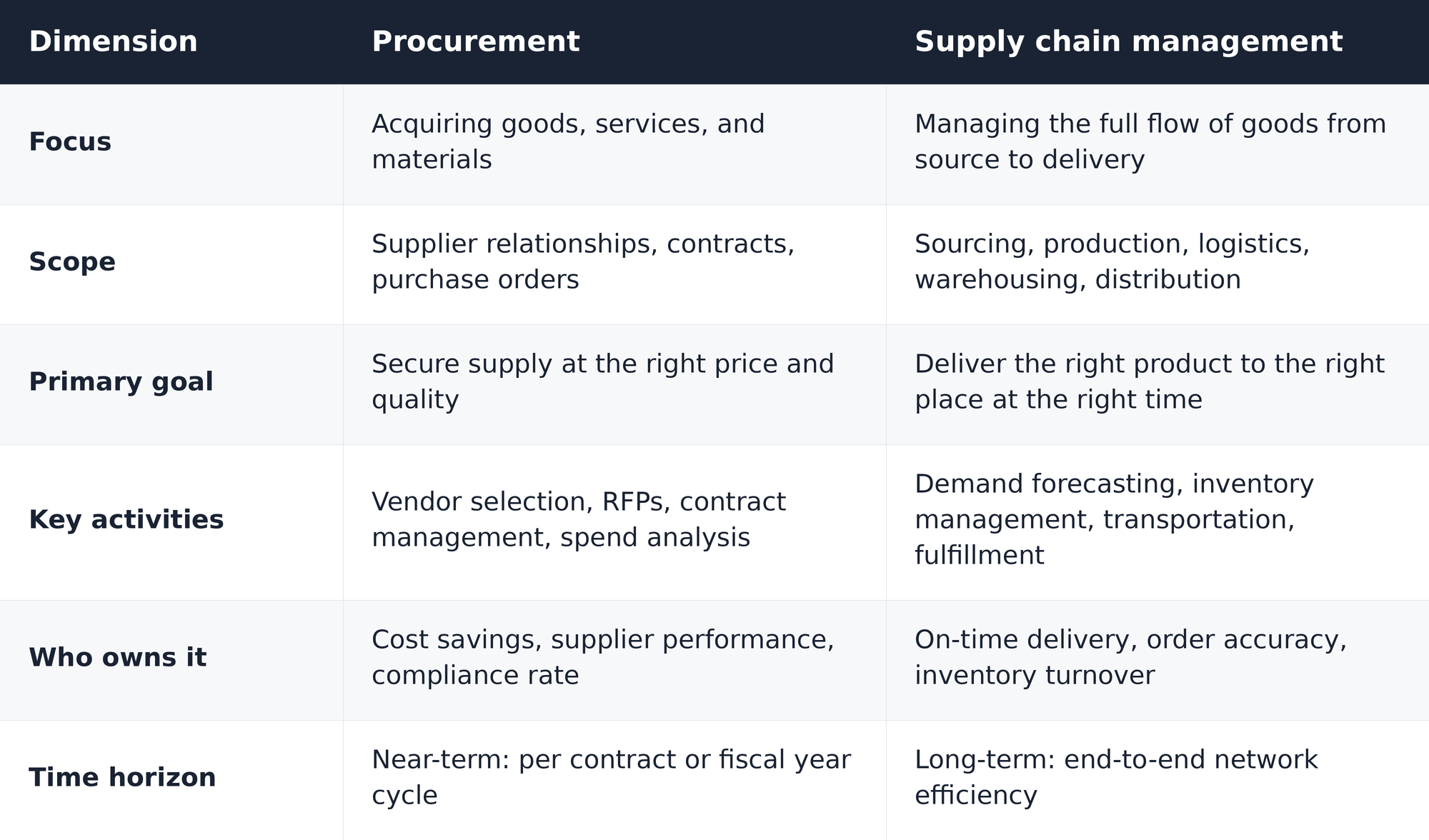
How procurement fits into the supply chain
Procurement decisions don’t stay in procurement. A supplier selection choice ripples into lead times, inventory levels, product quality, and logistics costs throughout the supply chain.
Consider demand forecasting. When procurement teams buy based on historical purchase orders without visibility into what the supply chain actually needs for the next quarter, they create mismatches. A company that over-orders based on last year’s run rates can end up with significant inventory carrying costs before finance notices the variance.
Procurement also plays a direct role in supplier performance tracking. When procurement teams monitor on-time delivery rates, defect rates, and lead time consistency at the supplier level, supply chain planners can build more accurate replenishment models. That tracking doesn’t have to be a manual spreadsheet exercise.
Strategic sourcing decisions made in procurement determine the health of the supplier relationships that the supply chain depends on. The two functions can’t succeed in isolation.
The procurement process in supply chain management
A structured procurement process is the backbone of supply chain coordination. Without it, purchasing decisions happen in silos, and supply chain leaders are left reacting to shortages, cost overruns, and compliance failures that procurement could have caught upstream.
Here are the seven steps most mature procurement teams use to connect sourcing decisions to supply chain outcomes:
1. Identify needs and requirements
A department or supply chain planner submits a purchase request based on demand forecasts, inventory targets, or operational plans. Procurement validates the request against existing contracts and approved supplier lists before proceeding.
2. Define specifications and quantities
Procurement works with the requesting team to define the exact requirements: technical specs, quality standards, quantities, and delivery timelines. Imprecise specs at this step cause problems at every step that follows.
3. Supplier identification and qualification
Procurement identifies potential suppliers and evaluates them against a defined criteria set: financial stability, production capacity, quality certifications, compliance record, and lead time reliability.
4. Request for proposal (RFP) or purchase order
For strategic categories, procurement issues an RFP to shortlisted suppliers and collects formal bids. For established suppliers and standard purchases, the team moves directly to a purchase order.
5. Supplier evaluation and selection
Bids are evaluated against cost, quality, lead time, and risk factors. The best procurement teams document their selection rationale here, especially when a lower-cost bid wasn’t chosen.
6. Contract negotiation and award
Procurement negotiates terms: pricing, payment schedules, delivery windows, service level agreements, and liability clauses. A well-negotiated contract reduces disputes downstream and gives supply chain planners reliable parameters to model.
7. Order management and performance review
After the order is placed and goods are received, procurement reviews supplier performance against the contracted terms. On-time delivery rates, quality acceptance rates, and invoice accuracy feed back into future sourcing decisions.
The benefits of aligning SCM and procurement
Aligning your supply chain management and procurement strategies comes with a range of benefits, including the following:
- Greater visibility: Gain visibility across the entire supply chain to identify risks and potential disruptions before they impact operations.
- Improved agility: Respond quicker to changes in markets and consumer preferences with an integrated approach.
- Better supplier relationships: Improve collaboration by developing strong supplier relationships throughout the supply chain.
- Reduced waste: Work together to prevent duplicative efforts, over-ordering, and underutilizing resources.
- Increased compliance: Standardize procedures to manage compliance with regulations and internal policies more effectively.
Challenges in supply chain procurement
Getting procurement and supply chain aligned isn’t a one-time initiative. The following six challenges recur across most organizations.
Supply chain disruptions and global sourcing risks
BCI found that nearly 80% of global organizations experienced at least one supply chain disruption in the prior 12 months, with most absorbing between one and ten disruptions during that period.
Disruptions expose two failure modes: over-reliance on single-source suppliers, and procurement strategies that prioritize lowest unit cost over resilience. Organizations that map their supplier dependencies to specific supply chain nodes before a disruption hits respond faster and absorb less cost when one occurs.
Cost volatility and inflation pressures
Cost management remains the most critical priority for one-third of corporate leaders globally in 2025, according to Boston Consulting Group.
Inflation pressure doesn’t distribute evenly across categories. Procurement teams that track cost variance at the category level, rather than the total spend level, identify exposure earlier and can renegotiate contracts or adjust sourcing strategies before variance becomes a budget problem.
Compliance, risk management, and ethical sourcing
Regulatory requirements around supplier conduct, labor practices, and environmental standards are tightening. Procurement teams now carry responsibility for verifying that third-party sellers meet these standards, not just that they deliver on time and within budget.
Compliance failures aren’t just legal risks. They’re supply chain risks. A supplier forced to pause operations due to a labor or regulatory violation creates an immediate sourcing gap. Procurement risk management frameworks that address compliance at the supplier level, not just the organizational level, are better positioned to avoid these gaps.
Procurement complexity in multi-location operations
Organizations buying across multiple facilities, regions, or business units often lack a unified view of what each location is purchasing. Without centralized controls, procurement loses buying power through fragmented spend, and supply chain visibility degrades.
Consolidating purchasing under a common system, with location-level customization where needed, is usually more effective than trying to enforce uniform policy across different operational contexts. Indirect procurement often drives the most fragmentation, as it’s harder to standardize than direct materials spend.
Mitigating the bullwhip effect in supply chains
The bullwhip effect describes what happens when small fluctuations in customer demand get amplified as they move upstream through the supply chain. A retailer orders 10% more product to buffer a demand spike. The distributor sees that order surge and orders 20% more from the manufacturer. The manufacturer signals a capacity increase to suppliers. By the time the original demand signal is visible, everyone is sitting on too much inventory, and the next cycle produces a shortage.
Procurement contributes to the bullwhip effect when it orders based on recent purchase history rather than current demand signals. The fix is behavioral as much as technical: procurement needs access to real-time inventory and demand data, and supply chain teams need to share forecast revisions before procurement places orders, not after.
Ethical and sustainable procurement requirements
Corporate social responsibility mandates are some of the biggest external challenges for procurement operations, above unexpected economic changes and rising costs.
More organizations are now expected to report on their supply chain’s socially responsible purchasing (SRP) outcomes: supplier diversity, carbon footprint, local sourcing, and labor standards. Procurement teams that build SRP criteria into supplier qualification and contract terms early have an easier time reporting on them later.
Procurement strategies in supply chain management
Strategic procurement differs from tactical procurement in one key way: it’s designed around supply chain outcomes, not just cost reduction. Tactical procurement asks “what’s the best price?” A strategic approach asks “what sourcing decision best supports our supply chain’s ability to deliver?”
Four strategies drive the most value at the intersection of procurement and supply chain management:
- Supplier diversification: Qualifying two or three suppliers per critical category reduces single-source dependency. It costs more to manage, but it absorbs disruptions without stopping production.
- Demand-driven procurement: Aligning purchase volumes to actual demand signals rather than historical purchase data reduces overstock and emergency orders. This requires procurement to access inventory and forecasting systems, not just spend reports.
- Category management: Grouping spend into categories managed by dedicated procurement leads gives organizations more bargaining power in negotiations and better visibility into total category cost. Pairing category management with procurement analytics surfaces spend patterns that aren’t visible when purchasing is fragmented across departments.
- Sustainable sourcing: Procurement teams that prioritize suppliers with relevant certifications, such as safety, diversity, or sustainability, reduce regulatory risk and support organizational goals around socially responsible purchasing.
4 best practices for aligning procurement with supply chain management
1. Increase collaboration and shared knowledge
Procurement and supply chain teams often work from different data sources and different planning horizons. Closing that gap starts with shared calendars and regular cross-functional reviews where both teams surface upcoming demand changes, supplier constraints, and cost pressures before they become problems.
2. Adopt joint procurement and SCM performance metrics
When procurement is measured on cost savings alone and supply chain is measured on on-time delivery, both teams can hit their own KPIs while degrading overall performance. Shared metrics, such as total landed cost, fill rate by supplier, and demand forecast accuracy, create accountability for outcomes neither team can control alone.
3. Leverage data for smarter decisions
McKinsey found that companies excelling in procurement had digital capabilities maturity scores 40% higher in strategy, digital, and data/analytics compared to average performers.
Access to shared spend and supply data is the practical enabler of every alignment strategy above. Amazon Business Analytics consolidates data from Amazon Business purchases across locations and teams, giving procurement and supply chain leaders shared visibility into spend patterns and supplier performance.
4. Invest in training programs
Procurement professionals who understand supply chain economics make better sourcing decisions. Supply chain planners who understand procurement constraints build better demand plans. Cross-functional training, whether through rotational assignments, shared workshops, or joint planning sessions, reduces the friction that comes from each team operating with a limited view of the other’s work.
Build a procurement strategy your supply chain can depend on
Supply chain procurement is complex, but most of the complexity comes from misalignment: between what procurement buys and what supply chain needs, between supplier terms and operational realities, and between cost-reduction targets and service level requirements.
Start by auditing where procurement decisions currently diverge from your broader SCM goals. Look at where emergency purchases occur most often, where supplier performance variance has the biggest operational impact, and where approval policies are regularly bypassed.
Amazon Business gives procurement teams the visibility and purchasing controls to stay aligned with supply chain strategy, without adding complexity. See how it works for your organization.
Get started today
FAQs about supply chain procurement
Was this helpful?




 United States
 India
India United Kingdom
 France
 Germany
 Spain
Spain Italy
Italy Canada
 Japan
Japan Mexico
 Australia


