
The full-cycle accounts payable process: 8 steps, KPIs, and best practices


Most finance teams know accounts payable is a cost center. The ones pulling ahead treat it as a control system: one that manages cash flow timing, reduces fraud exposure, and maintains the supplier relationships that the rest of the business depends on. An AP process that isn't integrated with procurement can be a direct source of cash flow leakage, compliance risk, and missed early payment savings.
Cost management remains one of the most critical priorities for corporate leaders. For finance leaders, that pressure lands squarely on the purchase-to-pay cycle, where indirect spend cost overruns most often begin.
This guide covers the full eight-step AP cycle, the benchmarks that separate top performers from the rest, and the improvements that make the biggest difference.
The accounts payable process: Why it matters
Accounts payable is more than invoice processing. It's the financial control layer that determines when and how much money leaves the organization, which suppliers get paid on time, and whether the business captures early payment discounts that translate directly to bottom-line savings.
When AP works well, finance leaders get accurate cash flow forecasts, clean audit trails, and supplier relationships that support favorable terms. When it doesn't, the costs are real: late payment penalties, missed discounts, duplicate payments, and the fraud exposure that comes from weak controls.
The AP process also connects upstream to supply chain and procurement decisions. Every purchase order that moves through your procurement system eventually becomes an AP transaction. The tighter the integration between procurement and AP, the fewer exceptions, mismatches, and manual corrections your team has to handle.
The 8 steps of the full accounts payable cycle
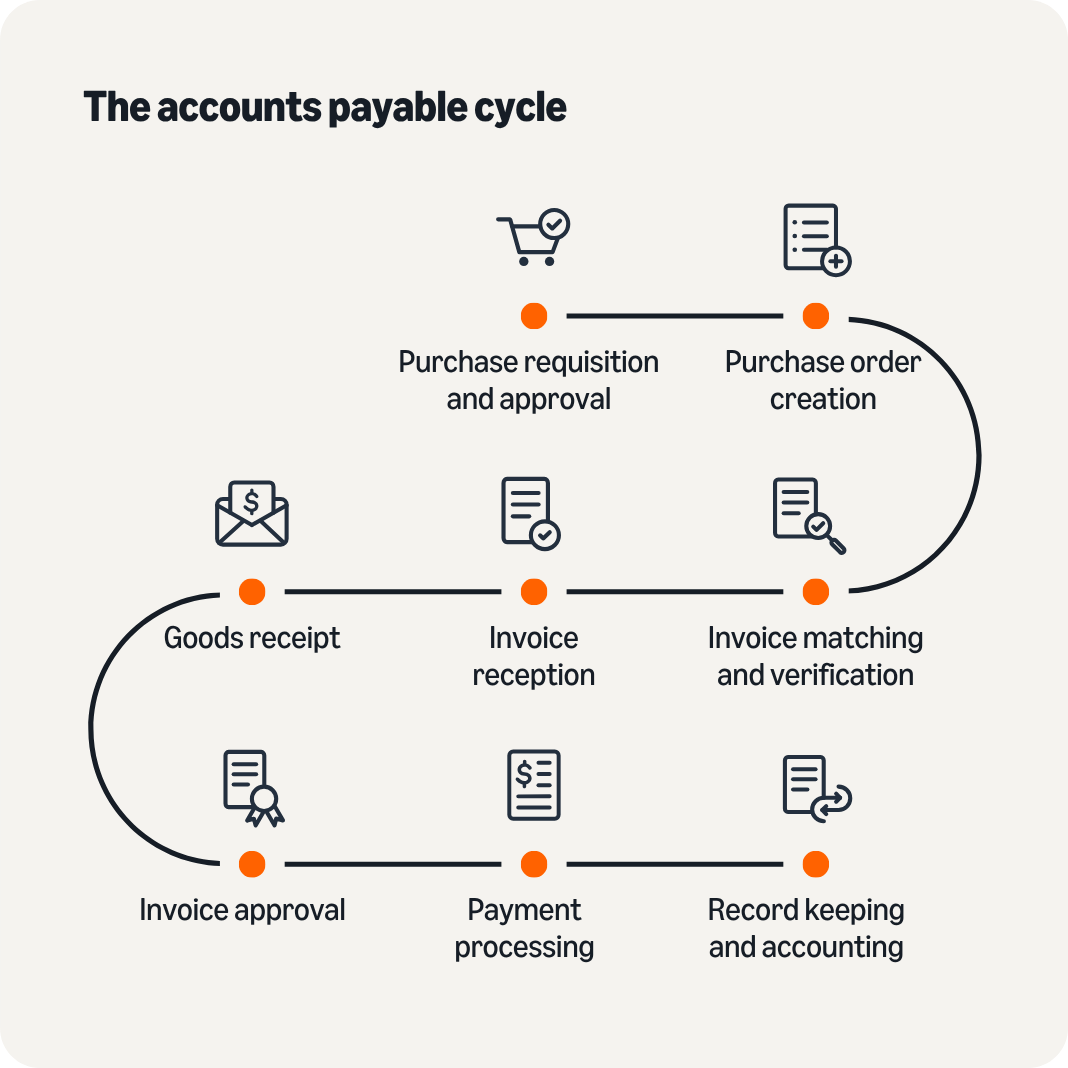
Here’s a look at the typical eight-step AP cycle:
Step 1: Purchase requisition
An employee or department submits a purchase request, either through a formal procurement system or directly to purchasing. This is the origination point of the AP cycle. Requisitions that include insufficient detail (missing PO numbers, vague specifications, unapproved suppliers) can create problems at every downstream step.
Step 2: Purchase order creation
Procurement reviews and approves the requisition, then issues a purchase order to the supplier. The PO establishes the formal terms: quantity, price, delivery date, and payment terms. Every field in the PO matters because it becomes the baseline for three-way matching later.
Step 3: Goods or services receipt
When the ordered goods arrive or the service is delivered, the receiving team documents what was actually received, including quantities, condition, and any discrepancies. This creates the goods receipt (GR) record, the second document in three-way matching.
Step 4: Invoice receipt
The supplier submits an invoice for payment. This is typically where fragmentation begins in organizations without a centralized AP workflow: invoices arrive by email, post, or supplier portal, and routing them to the right approver takes time.
Step 5: Invoice verification and three-way matching
AP verifies the invoice against the PO and the GR. The three-way match confirms that what was ordered, what was received, and what the supplier is billing are all consistent. Discrepancies here trigger exceptions that require manual investigation before payment can proceed.
Step 6: Invoice approval
Once verified, the invoice goes through an approval workflow based on purchase category, amount, and organizational policy. Approval bottlenecks are one of the most common causes of late payments and are usually a process design problem, not a personnel one.
Step 7: Payment processing
Approved invoices are scheduled for payment based on terms (net 30, net 60) and the organization's cash flow position. This is where early payment discount capture happens—or doesn't. Most manual AP teams miss the majority of available discounts because approval cycles are too slow.
Step 8: General ledger recordkeeping
Once payment is processed, the transaction is recorded in the general ledger. Accurate GL coding is critical for financial reporting, auditing, and cost analysis. Miscoded transactions create accounting errors that compound over time.
Understanding upstream vs. downstream workflows
There are two parts to every AP process: upstream and downstream workflows.
Upstream includes everything before the invoice arrives, such as creating purchase requests and POs and receiving goods or services. These steps usually fall under procurement.
Downstream kicks in after you receive the invoice and includes verification, approval, payment, and recordkeeping. This is typically finance’s territory.
When these two halves work in sync, you get a seamless, efficient purchase-to-pay cycle. When they don’t, you get delays, errors, and unnecessary costs.
Why you need a strong accounts payable process
When done right, your AP process becomes a hidden engine of efficiency and savings. Here’s how it can make a real impact:
- Better cash flow management: If you know exactly when money is going out, you can plan wisely, avoid surprises, and take advantage of early payment discounts
- Stronger supplier relationships: Paying on time builds trust and can open doors to more favorable terms, faster issue resolution, and priority treatment
- Increased cost savings: Keeping track of your AP process prevents overpayments and late fees while capturing every available discount
- Stronger business intelligence: AP data can help you spot trends, evaluate supplier performance, and make smarter procurement decisions
- Higher team productivity: Automation and streamlined workflows free your team to focus on strategic work instead of chasing down approvals
- Improved compliance and fraud prevention: Clear policies and controls reduce risk and align your organization with regulation
- Easier audits: With well-documented digital trails, audits become less disruptive and far less stressful
Having a well-documented AP process in place will also help your team protect themselves against potential roadblocks.
AP performance benchmarks
How does your AP team compare? These benchmarks, sourced from APQC's open standards benchmarking data, show the performance gap between manual and automated AP processes.
- Cost per invoice: Manual or bottom performer: $10–15. Automated or top performer: $2.82.
- Invoice cycle time: Manual or bottom performer: 14.6 days. Automated or top performer: 3–5 days.
- Invoices per FTE per year: Manual or bottom performer: ~6,082. Automated or top performer: 23,333+.
- Early payment discount capture: Manual or bottom performer: ~15%. Automated or top performer: ~75%.
- Touchless processing rate: Manual or bottom performer: < 40%. Automated or top performer: 60–80%.
- Invoice error rate: Manual or bottom performer: ~2%. Automated or top performer: < 0.5%.
Sources: APQC, Accounts Payable Key Benchmarks.
According to the Institute of Financial Operations & Leadership, 73% of AP teams aren’t fully automated, and 27% have no automation whatsoever, which means organizations that move early on AP automation can still achieve a meaningful performance edge over competitors still running manual processes.
Common AP process challenges
Even the most well-intentioned teams run into AP roadblocks. The key is knowing what to look for and how to fix them.
Here are a few common challenges you might encounter along the way:
1. Manual data entry and paper-based processes
Manual invoice processing is time-consuming and error-prone and creates bottlenecks as paper invoices move through approval workflows.
Solution: Start by digitizing invoices—even basic scan-and-store systems are more efficient than paper. Then, move toward full automation with optical character recognition (OCR) technology and integrated systems that work with your financial systems to eliminate double entry.
2. Invoice exceptions and discrepancies
When invoices don’t match purchase orders or receiving documents, resolving delayed payments can take more time than necessary.
Solution: Use a procurement tool that uses three-way match to enforce PO number, invoice, and goods accuracy up front and sets up clear exception-handling workflows with defined escalation paths. You should also track common exception causes to address recurring issues with specific supplier invoices or internal departments.
3. Lengthy approval cycles
Invoices can get stuck waiting for approval, especially if managers are traveling or juggling priorities.
Solution: Consider implementing approval thresholds that allow automatic processing of low-value, low-risk invoices to reduce processing time. Additionally, enable mobile access for approvals on the go, and use automation to send reminders and escalate overdue items. Finally, collect critical business order information from buyers during checkout to streamline financial reconciliation and approvals on the backend.
4. Poor visibility into payment status
Without centralized tracking, your invoice’s status is a guessing game.
Solution: A real-time AP dashboard makes it easy to track invoices and payments. Some systems let suppliers check status themselves, which reduces inquiry calls. Use this visibility to optimize payment timing based on cash position and available discounts.
5. Risk of fraud
Manual processes with limited controls create opportunities for fraud schemes.
Solution: Distribute AP responsibilities across multiple team members so there are more eyes on vendor onboarding, invoice entry, and payment authorization—no single person should manage all three. A larger oversight team, combined with automation that flags suspicious patterns and regular vendor audits, makes it easier to catch unauthorized changes before they become bigger problems.
What is a three-way match?
Three-way matching is the gold standard verification process in accounts payable that compares three critical documents to ensure accuracy and prevent data entry errors or fraud before you authorize a payment. These documents are:
- The purchase order
- The receiving report
- The vendor invoice
Only when all three documents align, confirming you received what you ordered and your bill is correct, should you approve the payment. This control mechanism ensures you only pay for authorized purchases you receive at the agreed-upon price.
Think of a three-way match as your financial safety net between invoice receipt and payment approval. This verification step is especially valuable when your business handles high transaction volumes or purchases complex items where discrepancies frequently arise.
While you'll likely find a three-way match to be the best approach, especially for larger processes, you may want to adjust the match type in different situations:
- Two-way match: This streamlined approach compares your purchase order against the invoice. It’s perfect for services or recurring payments without physical deliverables.
- Four-way match: For technical equipment or items that require quality inspection, this enhanced method adds inspection documentation to your verification process.
Pro tip: Amazon Business can help you automatically unite your order, invoice, and item receipt with 3-Way Match. You can even access 3-Way Match on the Amazon Business mobile app to easily reconcile purchases anywhere, anytime.
Build compliance and fraud prevention into your AP process
Your accounts payable department manages significant financial resources, which makes it both a prime target for fraud and subject to rigorous contract and process compliance requirements.
But rather than tacking on controls as an afterthought, you can bake them right into your AP workflow. Here’s how:
- Protect your vendor master file with formal verification processes for new vendors and changes to existing ones. You can also require verification steps for new vendors and account changes, especially bank details.
- Deploy intelligent monitoring that automatically flags suspicious patterns in your invoice flow. Reduce manual effort by leveraging technology that can instantly identify concerning indicators like unusual payment patterns or potential conflicts of interest.
- Maintain comprehensive documentation with clear audit trails—not just for regulatory compliance but also as a powerful deterrent for fraud by enabling the detection of suspicious or unauthorized actions. Including a timestamp and an approver’s name with every action discourages bad behavior before it starts.
- Stay vigilant through regular reviews since fraud tactics constantly evolve. Performing regular reviews, conducting surprise audits, and keeping up with fraud trends will help you catch vulnerabilities early.
By integrating these focused protection measures directly into your daily AP workflows, you’ll create a more secure process that can help safeguard your organization without creating additional work for your team.
Enhancing efficiency with AP automation software
If you’re looking for one upgrade that delivers measurable results quickly, AP automation is a great solution. According to a recent study, 93% of CFOs say that AP automation significantly reduced invoice tracking delays for their organizations.
Here's how automation can transform your accounts payable function:
End-to-end integration
Modern AP automation connects the entire purchase-to-pay cycle with:
- Seamless flow from purchase requisition to payment
- Elimination of manual handoffs between departments
- Real-time visibility throughout the process
- Consistent application of policies and controls
Intelligent document processing
Advanced technologies automatically extract and validate invoice data. Here are some examples of these technologies:
- OCR technology captures data from paper and digital invoices
- Machine learning improves accuracy over time
- Automated validation confirms purchase orders and receipts
- Exception highlighting enables focused human review
Workflow automation
Configurable rules guide invoices through your approval processes with:
- Automatic routing based on amount, department, or GL code
- Parallel processing for multi-level approvals
- Escalation paths for delayed approvals
- Mobile access to support approvals anywhere, anytime
Payment optimization
Strategic payment execution maximizes these financial benefits:
- Scheduled payments to optimize cash flow
- Automated capture of early payment discounts
- Diverse payment methods, including virtual cards
- Supplier payment preference management
Advanced analytics and reporting
Comprehensive data empowers strategic decision-making in these ways:
- Spend analysis by category, department, or supplier
- Process metrics like cycle time and exception rates
- Cash flow forecasting based on pending approvals
- Supplier performance tracking
How Amazon Business can help you improve your AP process
Bringing procurement and payment together can close the gap between your current cost per invoice and what top-performing AP teams achieve. Most of that gap comes from manual exception handling, fragmented purchasing data, and approval workflows that weren't designed for the volume they're processing.
Amazon Business integrates with 300+ procurement and ERP systems, so purchasing decisions and invoice data flow through your existing workflows without duplicate data entry. The Amazon Business Credit Account extends credit across purchasing categories with consolidated billing, reducing the number of payment transactions AP teams have to process.
Guided Buying enforces purchasing policies at the point of requisition, reducing the manual exceptions and mismatched invoices that slow down your AP cycle. When buyers can only purchase from approved suppliers at approved prices, the invoices that reach AP are already compliant.
Ready to see how your AP benchmarks compare and where Amazon Business fits in? Talk to an Amazon Business expert.
Get started today
FAQs about the accounts payable process
Was this helpful?




 United States
 India
India United Kingdom
 France
 Germany
 Spain
Spain Italy
Italy Canada
 Japan
Japan Mexico
 Australia


