
Inventory planning: A guide for modern organizations


Inventory planning serves as a critical bridge between operational efficiency and long-term scalability. Yet many enterprises still struggle to strike the right balance of ensuring product availability without tying up excessive capital in stock. Too much inventory increases carrying costs, while too little leads to stockouts, lost revenue, and dissatisfied customers.
In a market plagued by supply chain volatility, shifting demand patterns, and increasing pressure on margins and profitability, inventory planning demands a more sophisticated, data-driven approach. To build a resilient inventory planning strategy, technology leaders and procurement professionals need to move beyond reactive decision-making and adopt systems that provide visibility, automation, and predictive insights.
What is inventory planning?
The inventory planning process aligns supply and demand to ensure the right products are available at the right time. It determines how much stock to hold, when to reorder, and how to negotiate supplier agreements that protect against delays.
Inventory planning differs from inventory management, which is the process of receiving, storing, tracking, and issuing goods. You need both, but good management can't fix a faulty plan.
Effective inventory planning supports broader organizational goals like:
Cash flow management: Reducing excess inventory frees up capital for strategic investments.
Operational efficiency: Streamlined inventory reduces waste, storage costs, and manual intervention.
Customer satisfaction: Maintaining optimal stock levels prevents delays and stockouts.
Competitive advantage: Organizations that plan inventory successfully can respond faster to market changes.
According to McKinsey, companies that adopt advanced inventory optimization techniques, such as AI tools, can reduce inventory levels by 20-30% while maintaining or improving service levels, demonstrating the benefits of intentional planning.
Benefits of inventory planning
A well-executed inventory planning strategy goes beyond cost control to enable agility, resilience, and better decision-making at scale. Here are three specific benefits:
Frees working capital: Excess inventory locks cash in warehouses. Every order that sits for weeks or months without being used is capital you could've invested elsewhere. Inventory planning determines the minimum amount you need to maintain operations.
Prevents operational disruptions: For enterprises, a stockout in MRO supplies, IT equipment, or safety gear creates downstream disruption beyond the initial cost. A 15-minute delay at one step can become two hours across a whole production line. These delays are expensive and preventable.
Builds supplier relationships: Organizations that share customer demand forecasts with suppliers often get better pricing, priority fulfillment during shortages, and earlier warnings about supply chain issues. That makes supplier relationships a strategic advantage.
Challenges of inventory planning
Inventory planning isn't a set-it-and-forget-it solution. Knowing its top challenges can help you build processes and tools that adapt instead of break.
Demand volatility undermines forecasts: Unexpected fluctuations in demand can come from market changes, internal project spikes, or supply disruptions. Even with good data, you can't predict everything.
Data quality and data silos limit accuracy: Inventory decisions are only as good as the data behind them. If you can't get a clear view of what's actually being bought, where, and by who, the forecast starts on shaky ground.
Supply chain disruptions impact availability: Lead-time variance, supplier reliability failures, and transportation delays can all affect inventory availability in ways you may not see coming. When a two-week lead time becomes eight weeks, safety stock becomes your primary buffer. That buffer costs money, but not having it can cost more.
How inventory planning works
Inventory planning operates as a cycle with four interlocking parts where each step feeds the next:
Demand forecasting drives inventory targets.
These targets determine optimal stock levels.
Stock levels inform performance monitoring.
Monitoring closes the loop back to better forecasting.
1. Use demand forecasting techniques
Demand forecasting begins with two inputs: historical purchasing data and forward-looking signals.
Historical data reveals patterns, such as:
How much does your organization usually spend on office supplies in Q2?
How often do you reorder safety equipment?
What's the correlation between HR hiring bursts and IT equipment purchases?
Forward-looking signals, which include:
Known events
Budget cycles
Contract renewals
Facility expansions
Project pipelines
For example, if you're opening a new office or expanding an ecommerce fulfillment center in Q4, that drives a predictable increase in furniture, IT equipment, and safety supplies.
Demand forecasting for indirect spend differs from the forecasting used by retailers because you're not trying to predict consumer trends. Instead, you're forecasting requirements driven by headcount changes, operational calendars, and project pipelines. That's a more predictable pattern, but only if you start with good internal communication.
AI and machine learning are transforming demand forecasting into a competitive edge. Modern inventory planning expects forecasting that learns from patterns and adjusts automatically. If you're still running off historical averages and manual adjustments, you're at a disadvantage.
2. Set inventory targets
Inventory targets define how much stock your organization should hold to meet service goals. These targets are typically based on:
Desired service levels
Lead times
Demand variability
Procurement teams must align these targets with supplier capabilities and contractual agreements to ensure feasibility.
Economic order quantity (EOQ) determines optimal order size by balancing ordering costs against holding costs. Every order has a fixed cost, from processing to shipping and receiving, and every unit of inventory has a holding cost, such as storage, insurance, and obsolescence risk. EOQ finds the balance point.
3. Optimize stock levels and reorder points
Supplier lead times change, reliability shifts, and demand seasonality evolves. Effective inventory planning adjusts targets as conditions change.
For enterprise organizations, stock level optimization often requires cross-departmental alignment. Finance wants to minimize cash tied up in current inventory, operations wants zero stockout risk, and procurement wants a balance of both.
“Optimal” means different things to different departments. Good inventory planning makes that negotiation possible with data, not opinions.
4. Establish continuous performance monitoring
Your inventory plan is only as good as what you measure against it. Monitoring closes the planning loop and prevents drift.
Key performance indicators (KPIs) to monitor include:
Stockout rate: How often you run out of critical items
Inventory turnover ratio: How quickly you cycle through stock
Forecast accuracy: How close your predictions match actual demand
Supplier lead-time performance: Whether deliveries meet expectations
These are your signals for action.
How to implement an inventory planning strategy
Building a scalable inventory planning strategy requires a structured, data-driven approach. It also presents an opportunity to integrate procurement technology that enhances visibility and reduces manual effort.
Here are nine steps you can take to slowly build your strategy to success.
Step 1: Review historical and current data
Data siloes create blind spots, which is why consolidating your sales data is step one. Until you can see purchasing patterns, any plan you create is built on assumptions.
Audit purchasing records, supplier performance history, stockout incidents, and excess inventory by category. Focus on three signals:
Purchasing frequency by category (how often you reorder each type of item)
Lead time variance by supplier (how much delivery times fluctuate)
Seasonal demand spikes (when your organization uses more of certain supplies)
This will help you see where inventory is being consumed and where procurement is inefficient.
Step 2: Forecast future demand
Use your combined data to estimate how much inventory will be needed over a given time period based on historical purchasing data, seasonal patterns, and market trends. The best forecasts blend all three inputs.
Demand drivers for organizations differ from retail, as you're focusing on internal calendars, budget cycles, headcount growth, facility openings, and contract renewals. Those are foreseeable. If you know you're opening a new office or expanding a facility, you can build that demand into the forecast.
Even rough forecasts outperform reactive buying. A simple three-month rolling estimate beats no forecast at all.
Step 3: Prioritize inventory items
Not all inventory items deserve equal attention. High-value, high-frequency SKUs need tight controls and custom reorder points, while low-value, low-movement items can typically run on a simpler schedule.
Use prioritization methods like the ABC analysis to optimize your inventory:
A items (high value, high criticality) need tightly managed reorder points and real-time monitoring.
B items need periodic review, such as weekly or monthly.
C items can often be replenished in bulk on a fixed schedule.
You can also use XYZ analysis, which classifies items by demand variability, or identify items that are essential to your operations.
Another inventory planning method for direct procurement includes just-in-time (JIT) inventory, which is when suppliers align their raw-material purchases with production schedules. This reduces unnecessary storage.
Step 4: Establish inventory policies
Define clear rules for managing inventory, including:
Reorder points for each category
Safety stock based on lead time variance
Order quantities
Handling of obsolete or slow-moving items
For example, how long can an item sit before it needs special attention? What are your options for reducing excess inventory? This could include returns, liquidation, internal transfers, or donations.
Step 5: Align procurement policies with inventory targets
Translate your procurement strategy and inventory policies into purchasing rules:
Establish approved suppliers for each category.
Clarify lead-time assumptions.
Define approval thresholds and escalation paths.
For organizations operating across multiple sites or departments, this also means ensuring consistent purchasing policies across locations. Otherwise, one department overstocks while another stockouts.
A simple way to do that is to use a smart buying solution that enforces inventory policies automatically. That means implementing guardrails, like our Guided Buying feature, which:
Directs employees to pre-approved items and vendors
Sets guardrails like spend thresholds, category rules, and restricted items automatically
Routes requests through appropriate approval channels
Step 6: Evaluate and select suppliers
Supplier performance directly impacts inventory availability, which is why strategic sourcing plays a critical role in proper inventory planning. Evaluate suppliers based on:
Price
Quality
Reliability (on-time delivery rate)
Lead time
For organizations with socially responsible purchasing goals, supplier selection may also include certification requirements, such as safety, diversity, or sustainability.
Everything else is a tradeoff. For example, if a supplier offers a 20% price advantage but has 30% more lead-time variability, that impacts your inventory planning. You'll need more safety stock to buffer against delays.
Step 7: Negotiate contracts
Negotiate procurement contracts that lock in the assumptions your inventory plan depends on, like lead times, minimum order quantities, pricing tiers, and replenishment terms.
The best time to negotiate replenishment service-level agreements (SLAs) is before a stockout, not after. During a supply crisis, your relationship equity comes into play. Build it when everything is running smoothly, not when your inventory needs it.
Step 8: Automate ordering
Automation is essential for scaling inventory planning and works in two sequential steps:
Centralize inventory data
Automate replenishment triggers
Centralized data means consolidating purchasing information from multiple sources into a single, accessible format.
Once data and processes are in place, a buying solution enables automated procurement. The solution integrates with existing procurement systems, provides real-time purchasing data across categories, and can automate replenishment when stock hits predefined reorder thresholds, such as with Amazon Business Restock.
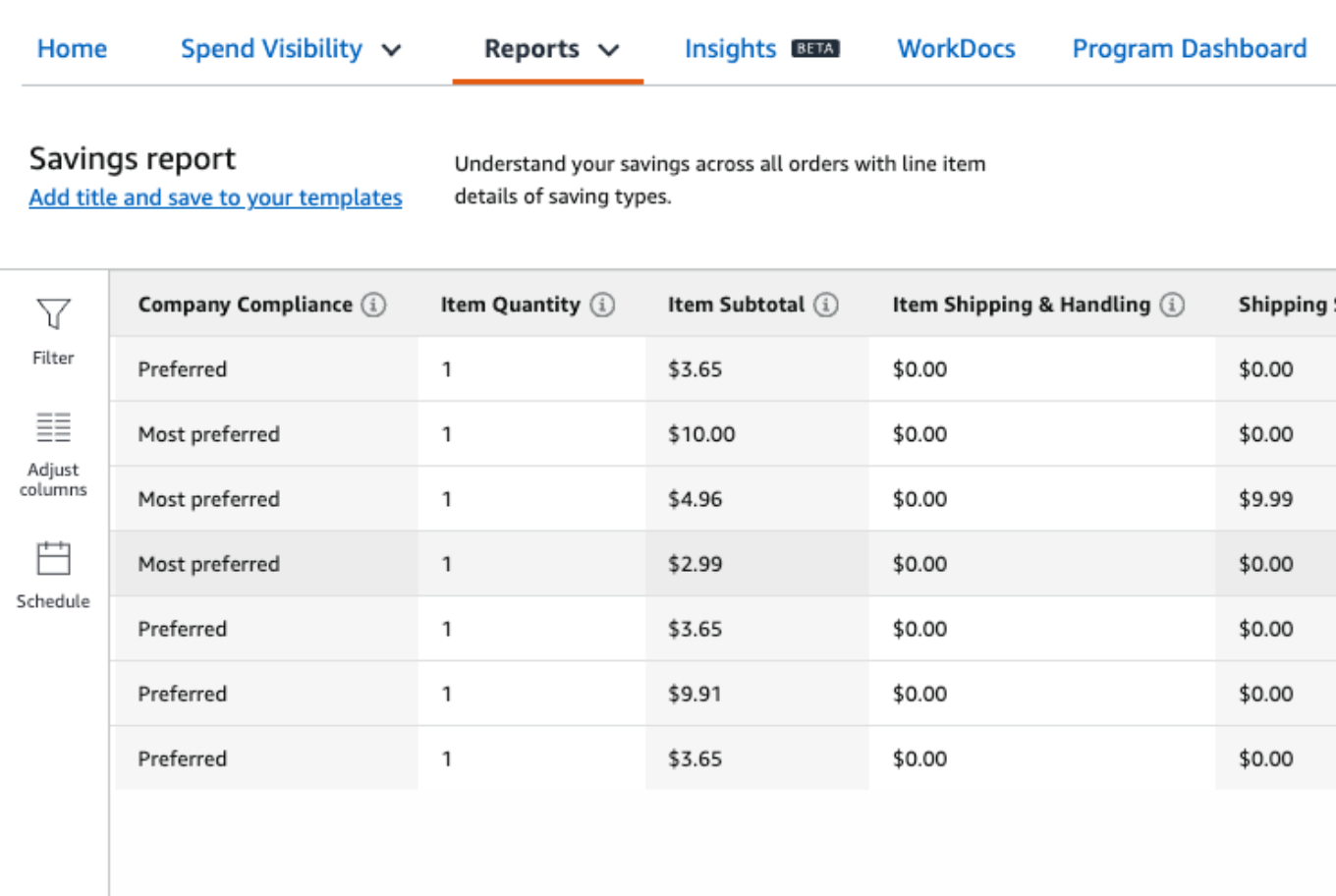
Image: Amazon Business Analytics lets users customize their savings reports to track spend patterns (Source)
Additionally, Amazon Business Analytics gives procurement teams real-time visibility into purchasing velocity and spend patterns, while Business Credit Account enables flexible payment terms on replenishment orders while maintaining cash flow control.
Accomplishing data centralization and automated ordering keeps compliance intact. Employees can't bypass purchasing rules intentionally or accidentally because the system only enables pre-approved options.
Step 9: Monitor KPIs and iterate
To understand the effectiveness of your inventory planning, track five core metrics:
Stockout rate
Excess inventory value
Inventory turnover ratio
Supplier lead time performance
Forecast accuracy
Regularly refining the strategy ensures continuous improvement and adaptability.
Key inventory planning software features
The right tool makes the process scalable. When evaluating inventory planning software, focus on capabilities that directly support your process.
Real-time inventory tracking
Real-time tracking lets you see the current amount of inventory you have across locations, categories, and suppliers without manual audits. This way, you can identify potential shortages before they become lost sales.
Amazon Business Analytics gives procurement teams cross-category visibility into purchasing history and trends so they can monitor spend patterns and identify reorder needs.
Automated demand forecasting
AI-driven forecasting has become a baseline requirement for modern inventory planning, not a premium feature.
Accurate forecasting tools that learn from purchasing patterns, identify trends automatically, and adjust predictions based on new data outperform static historical averages, especially when demand is irregular or driven by internal events like project launches or budget cycles.
Multi-location management
Multi-location management provides centralized visibility across sites, departments, and cost centers. Without it, one site might have excess stock while another experiences a stockout. Your inventory planning is sound, but your execution creates inefficiencies.
For enterprises, good multi-location management enables strategic inventory pooling and transfers. Instead of operating each site independently, you create a coordinated network.
Integration capabilities
Integration capabilities determine whether inventory planning data flows into your broader procurement ecosystem. ERP integration, procurement system connectivity, and robust API capabilities are essential for organizations running complex, multi-system environments.
Optimize your inventory planning today
The difference between inventory planning and reactive buying isn't just cost savings or stockout prevention. It's inventory control versus chaos. With a functioning inventory planning strategy, your procurement operation runs on data instead of firefighting.
You can start with the basics: clean data, consistent policies, and reliable suppliers. But to achieve full automation, where reorder alerts, purchase approval, and replenishment ordering happens automatically, you need a smart buying solution that integrates with your existing systems and enforces purchasing compliance at every step.
Amazon Business provides the real-time visibility, integration capabilities, and Guided Buying tools needed to transform a good plan into execution at scale. Contact our sales team to discover how inventory planning transforms manual guesswork into automated execution.
FAQs
Was this helpful?




 United States
 India
India United Kingdom
 France
 Germany
 Spain
Spain Italy
Italy Canada
 Japan
Japan Mexico
 Australia


